Productive disagreement depends on how people feel about each other.
We spend a lot of time thinking about how to argue, and not enough on how to shape the relationship that will define how the engagement goes.
It’s often said that in order to disagree well, people need to put emotions aside and think purely rationally, but this is a myth.
Disagreeing productively requires a bond of trust: a sense that we are ultimately working with, and not against, each other.
That’s an inherently emotional question as well as a cognitive one …
People are not purely rational, and acting as if they are leads to dysfunction.
We release the full potential of this disagreement when we incorporate our unreasonableness into the process.
Credit: Ian Leslie
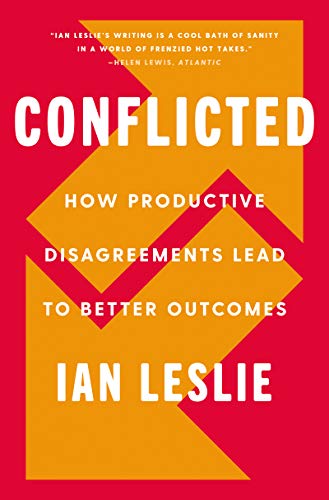 Comment: This quotation ties in well with the advice from Peter Block Connection before content – without relatedness, no work can occur.
Source: Conflicted (Page 55, paperback edition)
Posts where this quotation is embedded
- Disagree Constructively How to disagree well
Books: Ian Leslie (2)
Quotations: Ian Leslie (1)
Videos: Ian Leslie (1)
Quotations: Ian Leslie (1)
Videos: Ian Leslie (1)
Tags: argument (33) | constructive disagreement (17) | disagreement (13) | Ian Leslie (5) | reasoning (55) | relationships (31) | social reasoning (20) | trust (39)
Image Credits: Pixabay
 (Pixabay)
Gurteen Knowledge Café Workshop
Tuesday 20th October 2026, 14:00 to 18:00 London time (BST)
Learn how to design & run a Gurteen Knowledge Café, both face-to-face and online.
Information and Registration
Tuesday 20th October 2026, 14:00 to 18:00 London time (BST)
Learn how to design & run a Gurteen Knowledge Café, both face-to-face and online.
Information and Registration
This quotation is part of a blook on Conversational Leadership. It is one of many quotations that have influenced my thinking on the subject. Parts of this blook have restricted access. You may browse the pages open to you, but you will need to register and be approved before you can login and access the full site. When you register, you may also sign-up to receive a quotation of the day by email.