Reading Time: 2 minutes




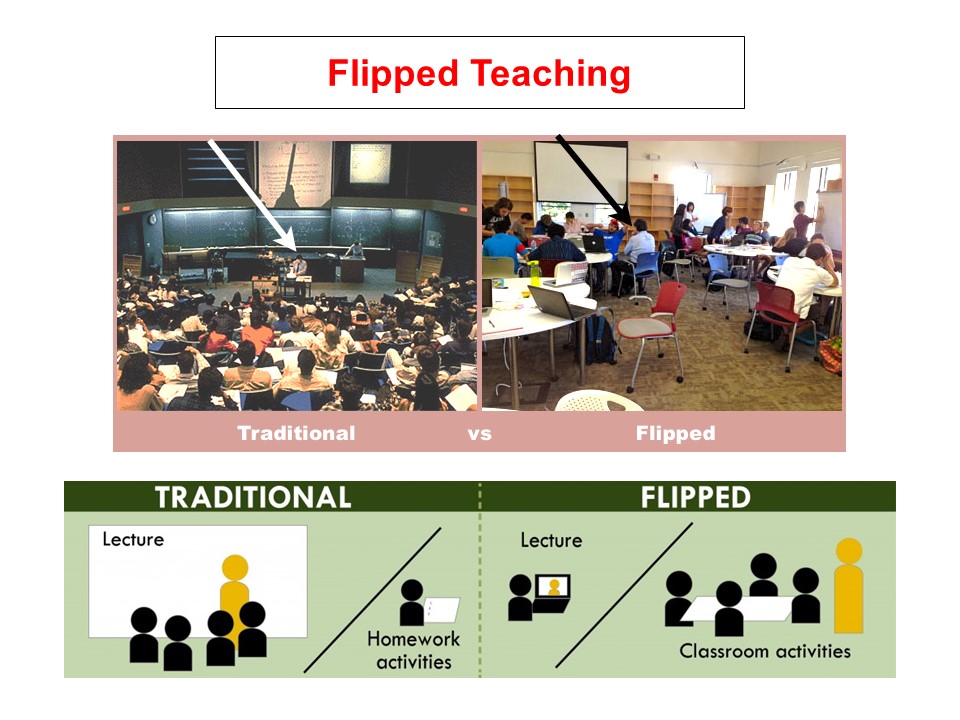
Flipped teaching reverses, or “flips”, traditional in-class lectures and homework. Students watch the teacher’s prerecorded lecture at home, and in-class time is used for students to test their skills, apply their knowledge, and interact through hands-on projects, discussions, and exercises.
Traditional lectures such as the one below can be sleep-inducing or worse:
Boring Economics teacher from Ferris Bueller’s Day Off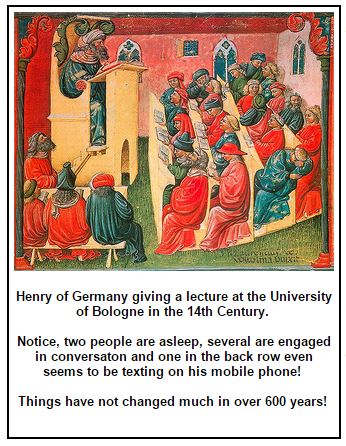
The idea behind flipped teaching is straightforward:
- Students watch video recordings of lectures in their place of choice in their own time.
- The time in class is now available for hands-on work and face-to-face interaction with teachers and peers.
The rationale is simple too:
- Speech is a bad medium for communicating information – so watch lectures and videos at home.
- Speech is a good medium for dialogue – so do hands-on work and face-to-face interaction with teacher/peers at school and speaker/peers at a conference.
Resources
- Blog Post: Why lectures are dead (or soon will be)
- Article: Twilight of the Lecture
- Article: Great lecture: what was it about again?
- Blog Post: Why I gave up flipped instruction
- Blog Post: What does research say about flipped teaching?
- Research Paper: The flipped classroom for teaching organic chemistry in small classes: is it effective?
- Research Paper: Design, Implementation, and Evaluation of a Flipped Format General Chemistry Course
Posts that link to this post
- Knowledge Café: Triggering the Conversation There are a number of ways in which you can trigger the conversation
- Knowledge Cafés at ING Bank, Netherlands Connect, connect, connect
- The Power of Peer Instruction Why explaining ideas to others leads to deeper learning
Status: Work in progress.
Tags: academia (8) | coaching (9) | education (34) | Eric Mazur (3) | flipped classroom (2) | Harvard University (6) | learning (40) | lecture (10) | oracy (22) | peer instruction (5) | peer learning (8) | teaching (5)
POST NAVIGATION
CHAPTER NAVIGATION
SEARCH
Blook Search
Google Web Search
Google Site Search
This page is part of a blook on Conversational Leadership. Parts of this book have restricted access. You can learn more about the book and how to obtain full access on the home page.
Gurteen Knowledge Cafés & Workshops
Join one of my upcoming Knowledge Cafés or workshops and explore Conversational Leadership in practice.
Engage in thoughtful conversation, challenge assumptions, and connect with others working in knowledge, leadership, and organisational change.