

We often rely on clear cause-and-effect reasoning when making decisions, assuming situations are stable and predictable. This breaks down in many real situations where uncertainty, complexity, and rapid change make analysis or best practice unreliable. The Cynefin framework offers a simple way to recognize context and respond appropriately.
The Cynefin framework is a conceptual framework created in 1999 by Dave Snowden to aid decision-making. It can also be described as a “sense-making device.” Cynefin is a Welsh word for habitat.
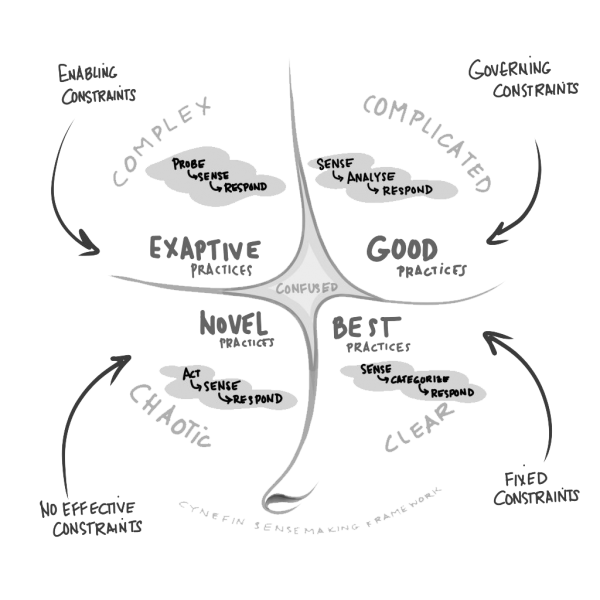
Cynefin comprises four decision-making contexts or “domains”: obvious, complicated, complex, chaotic, and a center of disorder.
The domains offer a “sense of place” for analyzing behavior and making decisions.
The domains on the right, obvious and complicated, are “ordered”: cause and effect are known or can be discovered.
The domains on the left, complex and chaotic, are “unordered”: cause and effect can be deduced only with hindsight or not at all.
Obvious
The obvious domain represents the “known knowns.” This means there are rules in place (or best practice), the situation is stable, and the relationship between cause and effect is clear: if you do X, expect Y.
The framework recommends “sense–categorize–respond”: establish the facts (“sense”), categorize, then respond by following the rule or applying best practice.
Complicated
The complicated domain comprises the “known unknowns.” The relationship between cause and effect requires analysis or expertise; there is a range of right answers.
The framework recommends “sense–analyze–respond”: assess the facts, analyze, and apply the appropriate good operating practice.
Complex
The complex domain represents the “unknown unknowns.” Cause and effect can only be deduced in retrospect, and no right answers exist.
The framework recommends “probe-sense–respond”: conduct one or more small fail-safe experiments (probe), sense what happens, and respond.
Chaotic
In the chaotic domain, cause and effect are unclear. Events in this domain are too confusing to wait for a knowledge-based response. Action – any action – is the first and only way to respond appropriately.
In this context, managers “act–sense–respond”: act to establish order; sense where stability lies; respond to turn the chaotic into the complex.
The Cynefin Framework | Dave Snowden (source)Making Sense of Complexity — an introduction to Cynefin | Jennifer Garvey Berger (source)
Closing Reflection
Resources
- Wikipedia: Cynefin Framework

- Harvard Business Review: A Leader’s Framework for Decision Making
 By Dave Snowden & Mary Boone
 - Article: The Cynefin framework: applying an understanding of complexity to medicine by Ben Gray
Posts that link to this post
- Complex Is Not the Same as Complicated We tend to use "complex" to describe things that are actually just complicated or challenging.
- Conversations Through the Cynefin Lens Unraveling the intricacies of everyday conversations
- In Complex Situations Cause and Effect Can Only Be Understood in Retrospect Why prediction breaks down in complex situations
- Nurturing an Innovation Culture Allowing emergence, not imposing change
- Retrospective Coherence in a Complex World How oversimplified narratives distort the past and hinder decision-making
- The Trouble with Optimization in a Complex World What maximizing and minimizing get wrong in complex contexts
- The Vector Theory of Change Navigating change in a complex world
- Two Worlds Learning to live in an entangled world
 (CC BY-SA 4.0)
Join one of my upcoming Knowledge Cafés or workshops and explore Conversational Leadership in practice.
Engage in thoughtful conversation, challenge assumptions, and connect with others working in knowledge, leadership, and organisational change.
I’m wondering how this framework relates to conversational leadership. Perhaps an example or case where this has emerged in either the Knowledge Cafes or other conversations. (You may be planning to add that type of content as you progress through the block.)
As follow-up to my earlier comment – As I moved around this topic on the block I got the connection. It was totally obvious to me at first.
Jo, this is just a placeholder. I have much more to write on this :-) Also as I write this book – its scope seems to be expanding beyond Conversational Leadership LOL