Every organisation faces different questions and challenges. A standard Knowledge Café may not always meet those needs. By shaping the conversation to fit your purpose and context, a customized Café creates the right conditions for people to talk, share experiences, and make sense of what matters most.
In a customized Knowledge Café, I work with you to design a Café tailored to your needs and context. This could be a single event or part of a wider programme.
For an introduction to the Knowledge Café concept, please visit this page. You can also explore videos of previous Cafés that I have hosted to get a sense of what the experience is like in practice.
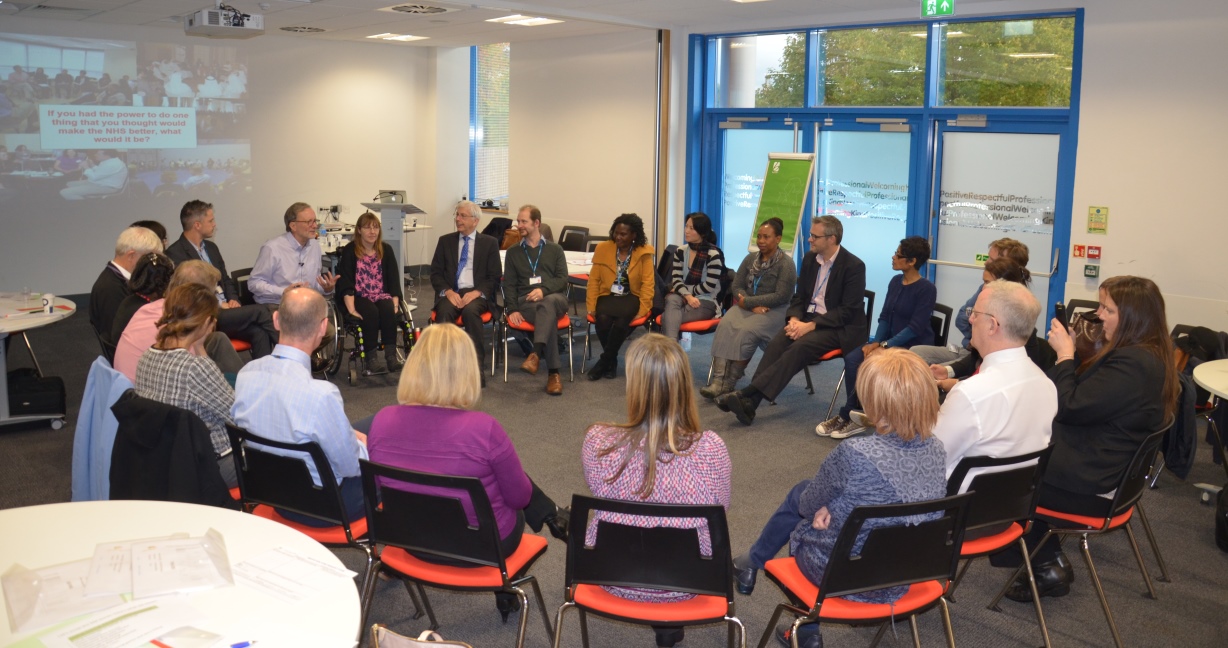
Here is a Knowledge Café, which I custom-designed and ran for Johnson & Johnson in Cork, Ireland, in November 2015.
Gurteen Knowledge Café: Johnson & Johnson Knowledge Café in Cork, Ireland, 2015 (source)Who it is for
I typically run customized Cafés in-house for staff, clients, partners, suppliers, or members of a business network, during the day or in the evening.
The Knowledge Café Process
The Knowledge Café offers a straightforward framework for engaging conversations. This is a high-level overview of the process.
- Participants are invited to an informal gathering designed for dialogue, not a meeting.
- The host welcomes everyone, explains the purpose, and introduces the process.
- A short connecting activity helps people engage with one another.
- A speaker offers a brief talk and poses a stimulating question.
- Participants discuss the question in small groups of three or four, moving tables between rounds.
- The event concludes with everyone gathering in a circle to share key insights and reflections.
For a more detailed description of the Café process, refer to this comprehensive description.
Ideal Setting
- A Knowledge Café works best under specific conditions that encourage rich conversation, facilitate easy movement, and foster a sense of intimacy among participants.
- Sessions usually last about two hours.
- The ideal group size is between 12 and 30 participants, with around 24 working best.
- The room should be small and cosy, helping people feel connected.
- Tables should seat three or four people. Small round tables are ideal, though small square or rectangular ones also work.
- Tables and chairs should be easily movable, with sufficient space to clear one side of the room and form a circle for the final group conversation.
Further Information
Adapting the Café
In practice, circumstances sometimes necessitate adjustments to the format. The Café can be shortened or accommodate more than 30 participants, but both changes have consequences.
The larger the group or the shorter the time, the more the quality of the conversation tends to decline. You lose the intimacy that comes from sitting in a circle. You may even need microphones, which create a very different dynamic.
Any change from the ideal format should therefore be considered carefully, as it can weaken the spirit and depth of the Café.
The Importance of the Circle
The final circle is a vital part of the Knowledge Café. It is the moment when everyone comes together to share their thoughts and insights from the small group conversations. The circle allows each person to see and hear everyone else, reinforcing the sense of equality that lies at the heart of the Café.
Circles work best with up to about 30 participants. Beyond that, they tend to become too large. Microphones may be needed, and the dynamic of the Café begins to change. The intimacy, spontaneity, and equality that make the circle so powerful are lost.
While it is possible to run a Café with a larger group, it becomes more of a presentation format, where people stand at their tables and report back using microphones. This approach can work, but it deviates from the true spirit and essence of the Knowledge Café.
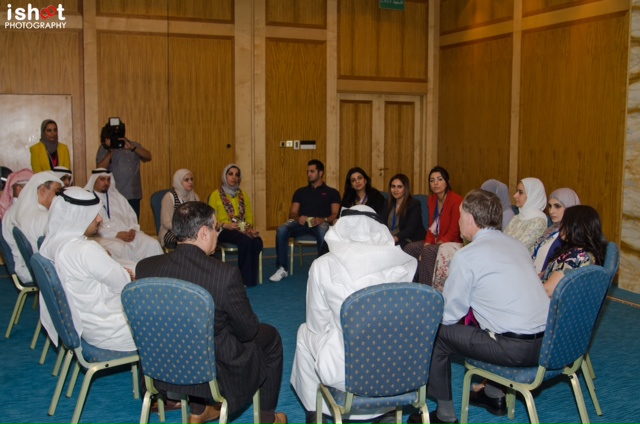
Gurteen Knowledge Café: RSA Workshop, London, 2011 (source)
Contact me to discuss your context, what you hope to achieve, and how a customized Café could help. I can outline design options and costs.
When we design a Café around a purpose, we make the conversation more relevant and valuable. By adapting the question, timing, and flow, we create an environment that allows the right people to engage and collaborate. Each customized Café becomes a shared learning experience shaped by what is genuinely needed.
If you enjoy my work and find it valuable, please consider giving me a little support. Your donation will help cover some of my website hosting expenses.
Make a donation