

Grammar shapes how we think about human activity. When living verbs become fixed nouns, we tend to treat dynamic processes as objects to manage. Revisiting the roots of conversation helps us notice this shift and return attention to the living act of conversing together.
We rarely notice what grammar does to us, yet grammar shapes how we think. The Latin conversari is a verb. It means to turn together, to live with, to keep company, to engage with others. It points to activity, movement, and participation.
Somewhere along the way, that living verb settled into a noun: conversation as we understand it today. This may seem trivial, but I do not think it is. When we turn a verb into a noun, we change how we relate to it. A verb is energy in motion. A noun is something we can point at, define, structure, and manage.
We see this pattern everywhere. Knowing becomes knowledge. Organizing becomes organization. Leading becomes leadership. Relating becomes relationships. The activity solidifies into an entity, and something subtle shifts.
From oral action to written object
I suspect the move from orality to literacy played a significant part in this. In oral cultures, language lives as action. Speaking is doing. Words are events. They happen between people and are inseparable from voice, rhythm, timing, gesture, memory, relationship, and shared context.
Speech unfolds in time. It cannot easily be separated from the people taking part in it. It leaves traces in memory and relationships rather than in fixed artifacts. Writing changes the ground beneath language. Once words can be fixed on a surface, they become inspectable. They can be analyzed, categorized, stored, transported, quoted, and owned. Language begins to behave more like an object than an event.
That shift favours nouns. Walter Ong’s work is helpful here. He argued that literacy does not simply change how we communicate. It changes how we think. It encourages abstraction, distance, analysis, and categorization. In oral cultures, language remains closely tied to action, memory, and relationships. In literate cultures, language becomes easier to treat as an object.
When language becomes visible and stable, we are encouraged to treat it as something we possess rather than something we enact. Conversation becomes something we have, lead, facilitate, improve, or evaluate. It becomes a unit of design.
We gain enormous advantages from literacy. Without writing, there is no science, no law, no history, no philosophy, and no coordination across distance in the way we know them today. But literacy also introduces a bias. It tilts us toward abstraction and away from immediacy. It privileges structure over flow. It makes it easier to mistake the representation for the living process.

What gets lost
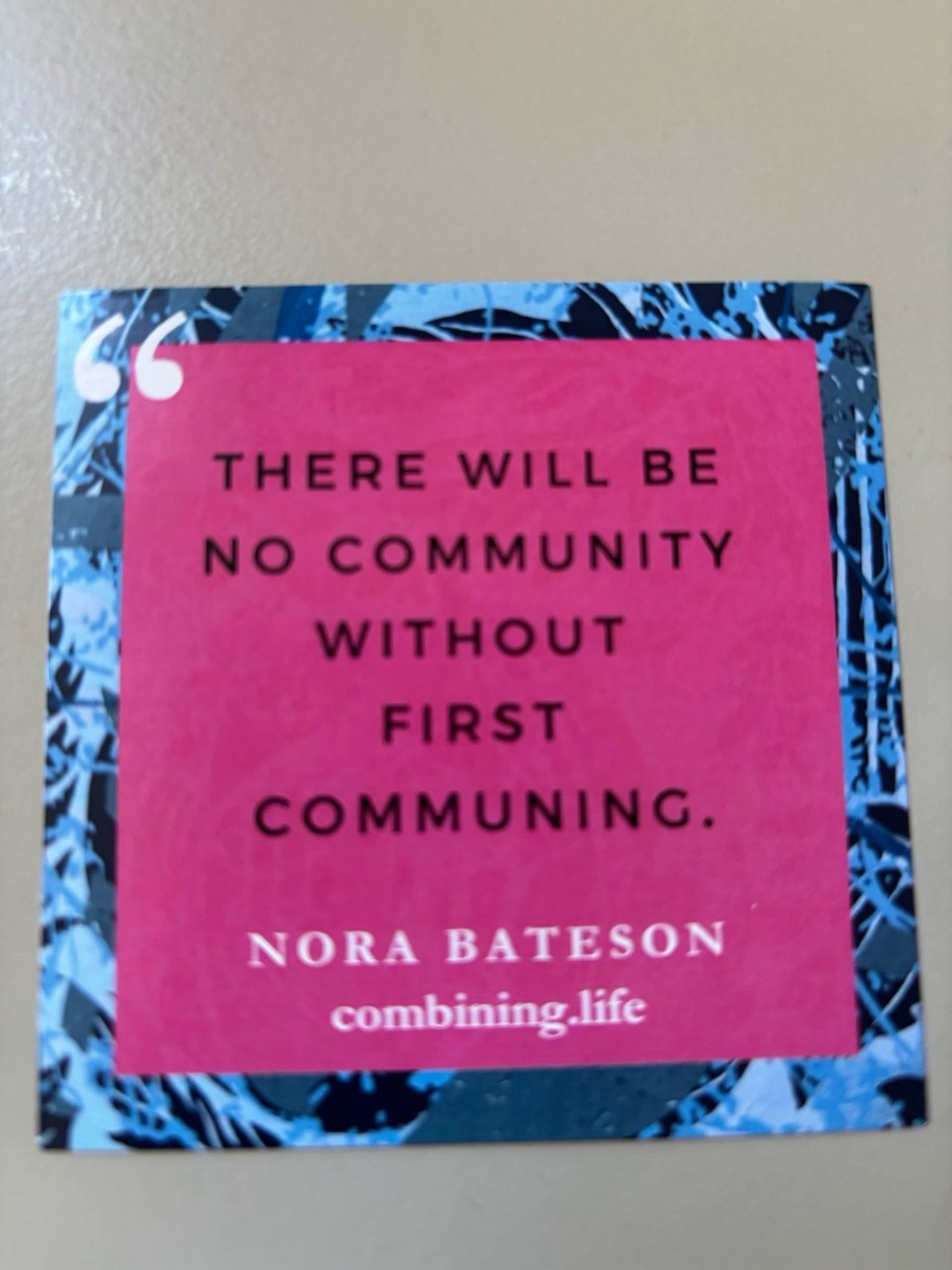 When conversing becomes conversation, some of the aliveness can drain away. A verb carries time, direction, and participation. It keeps us close to what is happening. It reminds us that we are involved. A noun, by contrast, can sit on a slide deck. It can become a competency, a method, a process step, or a management tool.
In the world of organizations, this matters. Once conversation is treated mainly as a thing, it can be designed, facilitated, measured, and optimized. Some of this may be useful, but it can also flatten the energy and dynamics of people turning together in real time.
Conversing is not simply an exchange of views. It is not a container in which meaning is transferred from one person to another. It is an unfolding activity in which meaning is made between us. Tone matters. Silence matters. Timing matters. Trust matters. The history between people matters. What is not said may matter as much as what is spoken.
These things are difficult to capture when we treat conversation as an object. This is not an argument against naming. Nouns allow us to reflect, remember, and coordinate. They give us handles. The problem arises when the noun eclipses the verb, when the map replaces the movement.
Keeping the verb alive
Perhaps the task is not to abandon the word “conversation” but to keep the verb alive within it. Conversation only matters because people are conversing. They are responding to one another, making meaning, discovering what they did not already know, and sometimes being changed in the process.
This small grammatical shift matters. Instead of asking, “How do we manage the conversation?” we might ask, “How are we conversing together right now?” Instead of asking, “What was the outcome of the conversation?” we might also ask, “What changed between us as we spoke?” Instead of treating conversation as a tool we deploy, we might begin to see conversing as a way of participating in the world.
The more literate and digital we become, the more this matters. We now live surrounded by text, transcripts, posts, documents, summaries, and prompts. Even AI invites us into something that looks like conversation, while much of it still takes place through written language. The boundary between speaking and writing is blurring again.
That makes the question more urgent, not less. Are we treating conversation as an object to optimize, or are we willing to return to conversing as a living act of turning together? The difference is not just linguistic. It shapes how we lead, how we learn, and how we relate.
 for inspiring me to write this post.
Closing Reflection
(Public Domain)Lead through presence and dialogue. This coaching helps you convene the important conversations others avoid—and grow your leadership by practicing, not just planning.