

Simply reframing a question can shift perspectives and dramatically change the resulting conversation.
I recently drew up a list of powerful questions that I felt would be good for sparking big talk, deep, meaningful conversations. The questions were based on some I had used in a couple of experimental Knowledge Cafés; I had dubbed Intimate Conversations, which in turn were based on Theodore Zeldin’s Conversation Dinners.
You will find my questions in the left-hand column of the table below.
I shared these questions with my good friend Charles Savage in Munich and was delighted by his insightful reply.
Shifting perspective
Ferdinand Tönnies
wrote about “ Gemeinschaft and Gesellschaft” – community and association.
Our Industrial Era moved us from our caring communities to individualistic associations.
We’ve built an economy focused on inspiring/motivating the self-interest of individuals, rather than one where we co-create one another in deeper conversations.
Notice that most of your questions are about the “individual” and few are about our nurturing “community”.
Might it be possible to shift a bit the perspective of the questions?
Credit: Charles Savage
Charles then suggested some community alternatives to my individualistic questions, as shown in the table below.
| Individual Perspective | Community Perspective |
| What brings you the greatest happiness when you think back on your life? | How do you bring out the best in other people? |
| What would you like to see engraved on your tombstone? | What words of thanks for this life would you leave on your tombstone? |
| What are your earliest memories of your childhood? | At what age did you become aware of the importance of interaction with others? |
| What is the one thing you’d still like to learn? | If you could teach others one thing, what would it be? |
| What motivates you to get up in the morning? | If the day were an artist’s canvas, what painting are you compelled to develop? |
| If you could do whatever you wanted, what would that be? | If you could do whatever you wanted to enable your best friend to be more than they ever realized, what might it be? |
| Describe your perfect partner. | What might you do to bring out the perfection in your partner? |
| In what way do you plan to leave the world a better place when you die? | How has the world allowed you to be a better person than you ever realized possible? |
| Is it inevitable that new ideas should meet resistance? | Steel is tempered with heat. How might we see resistance as toughening us up for the task ahead? |
| When are you at your best? | When and how do you enable others to be at their best? |
| When have you felt lonely and isolated? | Through empathy, how have you reached out to those lonely and isolated? |
| What sensations do you avoid? | What do sensations teach you about the multi-dimensions of life? |
| What do you need more or less of? | How does your life enrich that of others? |
| What are the limits of your compassion? | Why do you limit your compassion for others? |
| What emotion could you do without? | How do your emotions, intuitions, memories, skepticism, and visions add to the lives of us all? |
The individualistic paradigm runs so deep that I had never seen it before in this context. Google “meaningful conversations” or something similar, and you will find that almost all the questions are identical to mine – they come from an individualistic perspective, not a community one, as in Charles’ examples.
The questions remind me of Henry Mintzberg’s concept of communityship. If we were indeed part of a community, there are the sorts of questions we would ask ourselves.
What problems do you want to solve?
Here is another example of a shift in perspective.
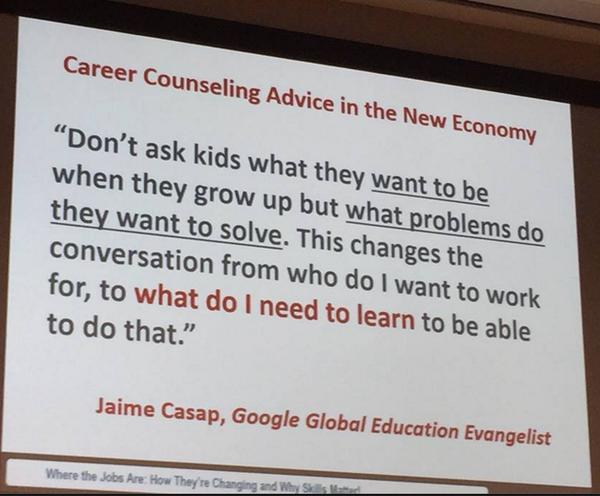
I stumbled across this photo of a slide by Jaime Casap. It shifts the thinking and the conversation, doesn’t it? Like Charles’ shift in framing my questions, it moves from an individualistic perspective: What do you want to be? to a community perspective: What do you want to do for the world?
When crafting a question for a Knowledge Café or any other conversation, think about how a shift in perspective might immensely increase its power.
Posts that link to this post
- How to Design Powerful Questions Questions open the door to dialogue and discovery
- Make Big Talk Make big talk not small talk
 (CC0 1.0)
The Gurteen Knowledge Letter is a free monthly newsletter with over 20,000 subscribers that I have been publishing by email for over 20 years.
Learn more about the newsletter and register here.