

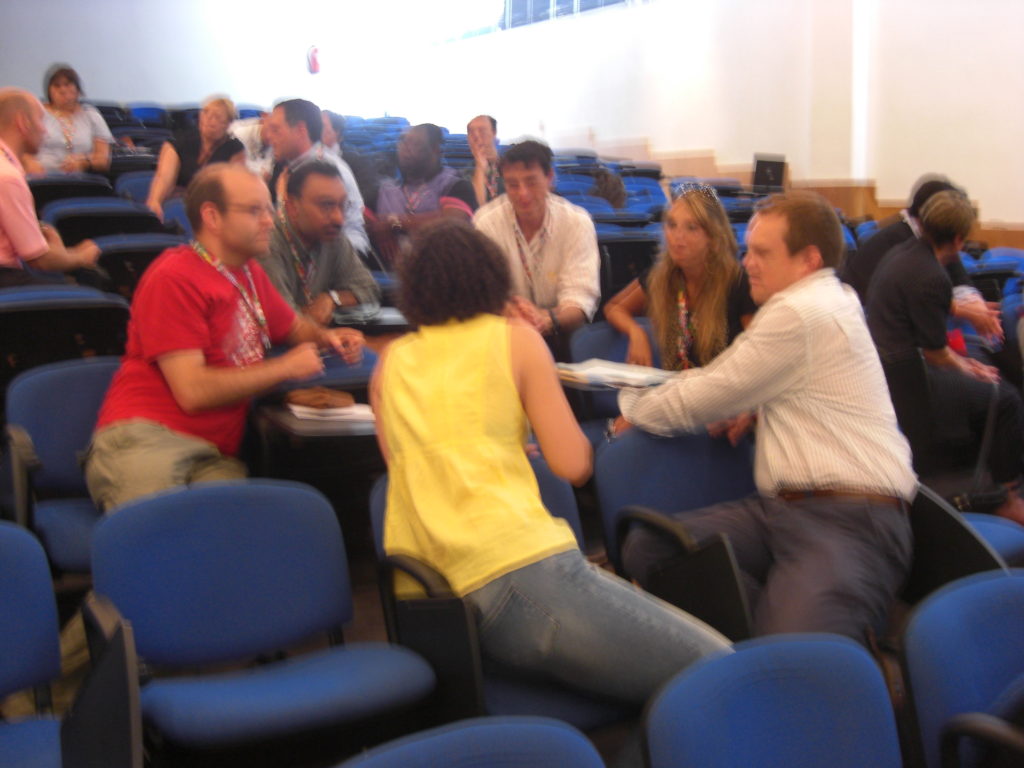
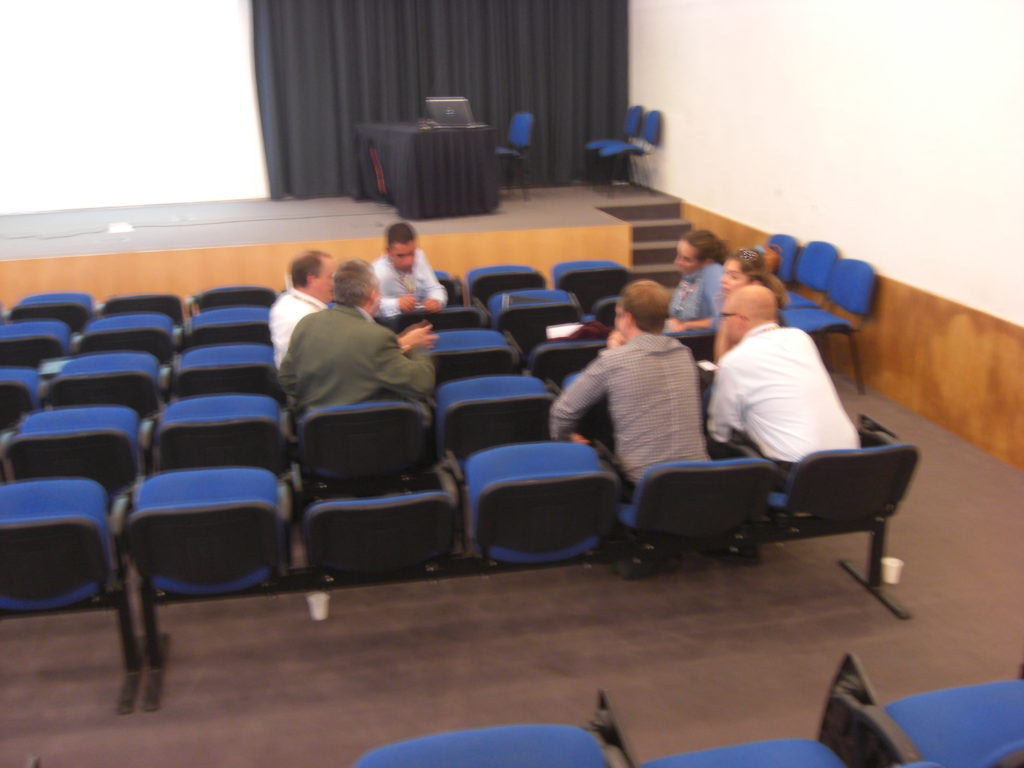
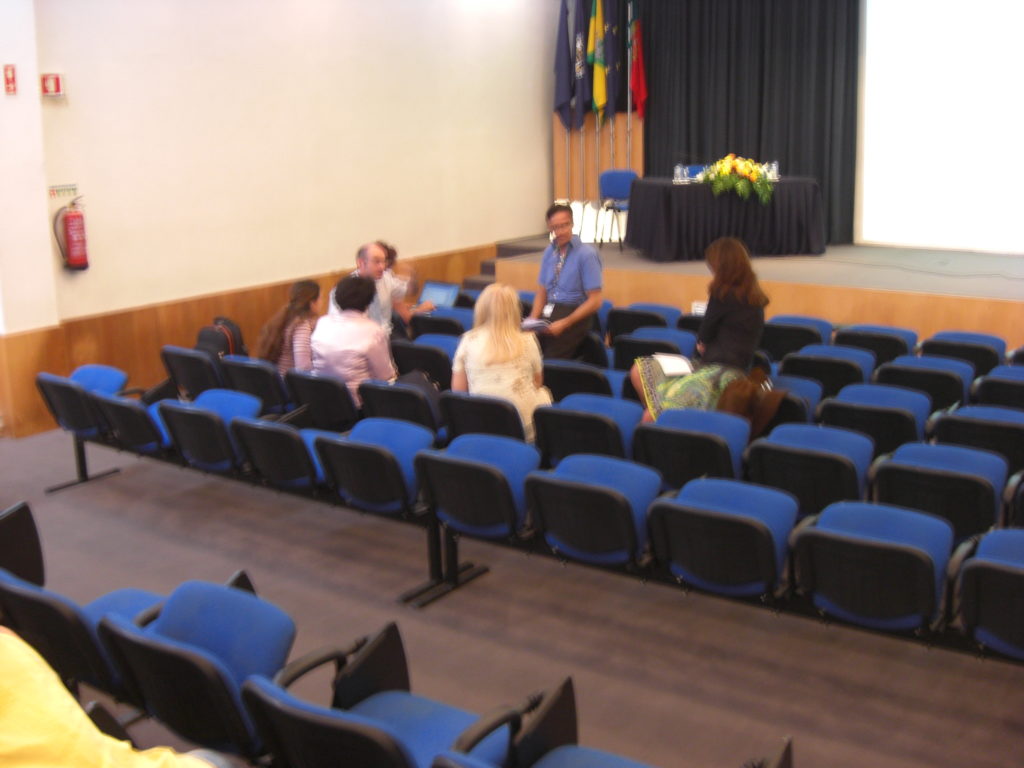
I would not advise running a Knowledge Café in a lecture theatre unless you have no real choice, but it can be done. The photographs show what it looks like in practice. People can turn to those around them and talk in small groups, but the arrangement runs counter to the spirit of the Café.
A Knowledge Café depends on ease of movement, informality, and a sense of closeness. People need to be able to sit comfortably with three or four others, look at each other, listen without strain, and feel that they are part of a shared conversation rather than an audience. A lecture theatre is designed for something quite different. It is designed for people to face the front, listen to a speaker, and remain largely in place.
This matters more than we sometimes realize. The physical layout of a room shapes the conversation that takes place within it. In a flat room with small tables or loose chairs, people can gather naturally, move between groups, and later form a whole-group circle. In a lecture theatre, the seating fixes people into rows. They can talk to those immediately beside them, in front of them, or behind them, but it is awkward. They have to twist around, lean across seats, or raise their voices. This makes the conversation less relaxed and less intimate.
The small groups also tend to become too large or too unevenly formed. Rather than groups of four or five people sitting around a table, you often end up with scattered clusters of people talking across rows. Some people are easily included, while others are left at the edges. It is much harder to create the gentle, conversational energy that comes when people sit close together and can see each other’s faces.
The biggest loss is usually the circle at the end. For me, the final whole-group conversation is an important part of the Knowledge Café. It allows people to hear a range of reflections from across the room, not as formal feedback from groups, but as a shared conversation. In a lecture theatre, a real circle is impossible. People remain in rows, facing the front, and the dynamic easily slips back into a question-and-answer session with the speaker.
That said, if a lecture theatre is the only room available, it is still possible to do something useful. The important thing is to acknowledge the limitations and work with them. Keep the opening remarks short. Invite people to form small conversational clusters with those nearest to them. Encourage them to turn fully towards each other as far as they can, rather than half-talking while still facing the front. Make it clear that this is not a discussion with the speaker, but a conversation among themselves.
You may also need to accept that the Café will be less fluid than usual. People will not move easily between groups, and the final plenary will not be as high-quality as a circle. Rather than trying to force the usual format, it may be better to treat the session as a modified Knowledge Café: a conversational session inspired by the Café, rather than a full Café in the usual sense.
The lesson is simple. Room layout is not a minor logistical detail. It is part of the conversational design. If we want people to think together, we need to give attention to the conditions that make that possible. A lecture theatre tells people, physically and psychologically, that they are an audience. A Knowledge Café invites them to participate in a shared inquiry. Those two things are not impossible to combine, but they sit in tension with each other.
So, yes, a Knowledge Café can be held in a lecture theatre. But it is far from ideal. Use such a space only when you must, adapt the process carefully, and do not expect the same intimacy, movement, or energy that you would get in a room designed for conversation.
Join one of my upcoming Knowledge Cafés or workshops and explore Conversational Leadership in practice.
Engage in thoughtful conversation, challenge assumptions, and connect with others working in knowledge, leadership, and organisational change.