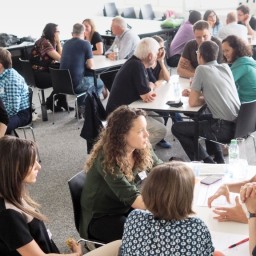


Introduction: Community ** Members of a community care about each other
[InsertQuote id="quote-transform-ourselves-into-community-creatures/" align=""] Continue reading Introduction: Community ** Members of a community care about each other
an online book by David Gurteen

An enterprise is a community of human beings, not a collection of human resources.
[InsertQuote id="quote-transform-ourselves-into-community-creatures/" align=""] Continue reading Introduction: Community ** Members of a community care about each other
Without care, society would be impossible. Caring is at the root of creating a better world. If we care, we take responsibility. Continue reading Care ** We naturally take responsibility for the people and the things that we care about
A community is more than just a group of people with shared interests. Many networks and organizations call themselves communities, but they often lack the deeper connections that make a real community. True communities grow over time through meaningful relationships, shared purpose, and mutual care—not through design or construction. Continue reading What Makes a Real Community? Members of a community care about each other
Organizations are more than collections of individuals. They depend on relationships, shared purpose, and our willingness to take responsibility for the whole. Henry Mintzberg’s concept of communityship challenges the emphasis we place on individual leadership and draws attention to what we can accomplish when leadership, responsibility, and care are shared. Continue reading What Is Communityship? Where everyone in a community practices leadership
Politics shapes decisions and outcomes in organisations, communities, and everyday life, not only in government. It is often reduced to manipulation, self-interest, and office games, which leads many people to deny or avoid it. A broader definition shows politics as influence and action, making things happen without abandoning ethics. Continue reading Politics Is Life We can’t escape it
People often say, “I have no choice,” but that’s rarely true. Even in the most challenging situations, we can choose our attitude, response, and actions. These insights from Viktor Frankl, Stephen Covey, Peter Block, and Peter Koestenbaum remind us of the power and responsibility of choice. Continue reading We All Have the Freedom to Choose If We Choose To The last of human freedoms
Lashon Hara, or harmful speech, is a longstanding Jewish prohibition with deep ethical roots. While many cultures condemn lies, this law goes further—truthful but damaging words are also forbidden. The challenge today is how to honour that principle while still addressing wrongdoing, injustice, and difficult truths responsibly. Continue reading Lashon Hara Jewish religious term for derogatory speech
An interesting conundrum arises when considering the Jewish religious law forbidding Lashon Hara (speaking derogatorily about someone) and building social trust through gossip. Why would Jewish religious law consider gossip bad while anthropologists consider it good? Continue reading Gossip and Lashon Hara Conversation about other people
Leadership is often associated with authority and position. That can make many of us believe leadership belongs to someone else. A better view sees leadership as a practice that anyone can choose to develop. Continue reading Leadership Is a Practice Not a Position of Authority Anyone can practice leadership
Organizations often design change through plans and then seek buy-in from others to implement them. This approach creates resistance, weak commitment, and superficial compliance rather than real engagement. A more effective path is to involve people early, enabling shared ownership so change emerges through participation, contribution, and everyday conversation. Continue reading Ownership, Not Buy-in We need to move from buy-in to ownership
Culture plays an essential role in our societal and organizational lives. It shapes us in a variety of ways. Continue reading Culture Basic tacit assumptions about how the world works
Simply reframing a question can shift perspectives and dramatically change the resulting conversation. Continue reading Reframing Questions Shifting perspective changes the conversation
Trust is the force that holds our society together. It is the glue that connects us, builds communities, and is one of the foundations on which society depends. It is vital for society to function. Our civilization would collapse totally without it. Continue reading Exploring the Multifaceted Roles of Trust in Relationships and Society Without trust our civilization would collapse
What is “the comedy or cornucopia of the commons”? How does it contrast with the “tragedy of the commons”? Continue reading Raising the Ships on the Sea The comedy or cornucopia of the commons
People see themselves as the hero of their own story. This makes it easy to justify actions, even when they harm others. Understanding this can open the door to real conversations instead of endless conflict. Continue reading Everyone Believes They’re the Good Guy The only real way to disarm your enemy is to listen to them
We need to work together rather than trying to manipulate each other. Far too often in the workplace, at all levels, we try to do things to people – we try to make them conform to some desired way of being or working. We ask questions like “How do we make people share?” or “How do we make people take more responsibility?” We use that make people phrase a lot! Just go to Linkedin and look at all … Continue reading Working Together ** Working together rather than manipulating each other
We are all human, but we are all different. But how different? And what is the implication of those differences? Continue reading We’re All Different ** We need to get to know each other better