

Knowledge Management is often framed as getting the right information to the right people at the right time. This works well in some situations, but often fails to change behaviour or practice. A broader view is needed, one that takes account of context, constraints, and how people make sense of situations together.
The Information Deficit Model is a communication framework often applied in fields like science communication, public health, and environmental advocacy. It suggests that when individuals or groups reject expert advice or adopt “misguided” beliefs, the root cause is a lack of “knowledge”. According to this model, providing accurate information is the solution to aligning people’s beliefs and actions with expert perspectives.
Although the term originated in science communication, the underlying assumption is far more widespread. It shows up in many areas of everyday communication, where the default response to disagreement or poor decisions is to provide more or better information.
At its heart sits a simple belief that our views are largely rational and that if others had access to the “correct” information, they would recognize their error and change their thinking. In practice, people often resist, reinterpret, or ignore information that challenges what they already believe.
The Information Deficit Model is usually framed in terms of belief change. If people hold the wrong views, the assumption is that providing them with the right information will correct them.
In Knowledge Management, a similar assumption appears in the familiar but flawed idea that KM is about getting the right information to the right people at the right time.
These are not identical situations, but they rest on the same underlying belief: that information is the limiting factor and, once provided, the desired outcome will follow.
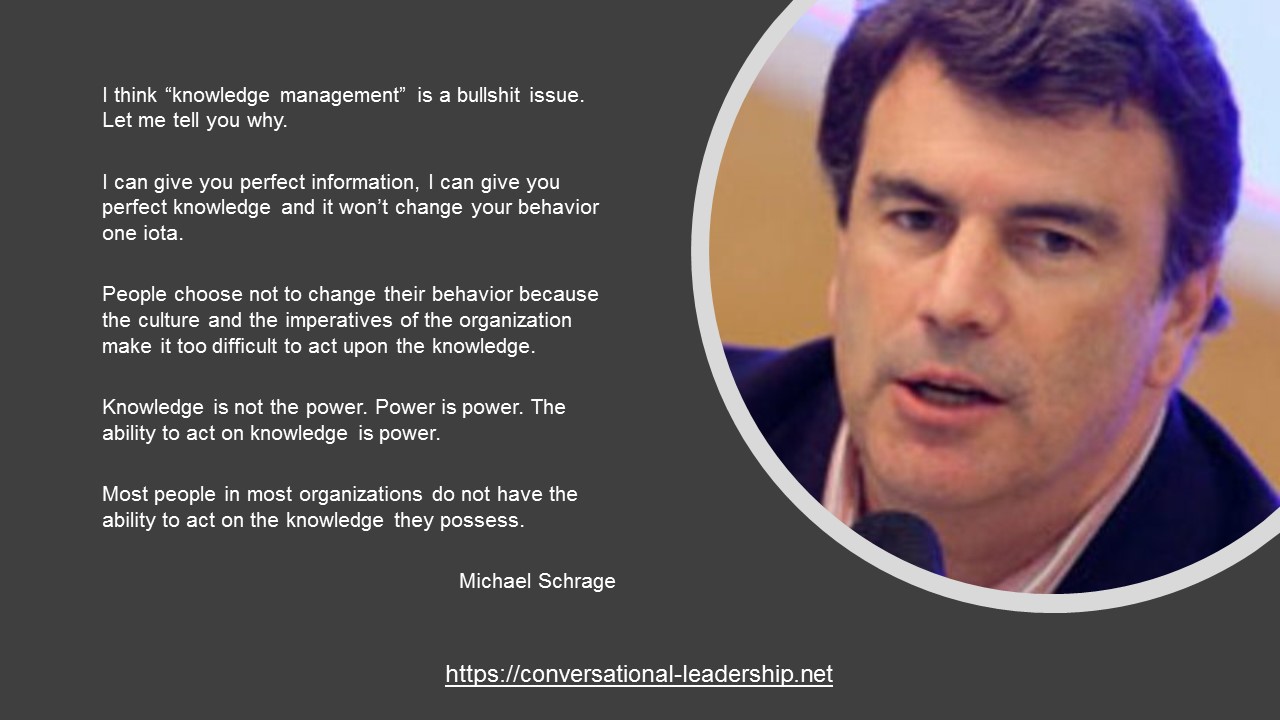
In practice, both run into the same issue. People may understand perfectly well what to believe or what to do, and still not change. Behaviour is shaped not only by interpretation and interaction, but also by constraints, incentives, risks, and what is practically possible in the moment.
Why it appeals
It is an appealing idea. It is simple, intuitive, and it aligns neatly with how many KM initiatives are framed.
Often, the issue is not that people are doing the wrong thing, but that they simply do not know how to do something. They need to find a document, follow a procedure, or understand a process. In these situations, it makes perfect sense to provide the relevant information.
If people lack what they need to act, then giving it to them can help them get on with the job. For straightforward questions such as “where do I find this?” or “how do I do this?”, this works well.
These tend to be more stable and bounded situations, closer to what the Cynefin framework would describe as simple or, at times, complicated domains.
The difficulty is that this logic is then extended far beyond these cases.
There is a substantial body of research showing that providing information, even when it is accurate, timely, and well structured, does not reliably lead to changes in belief or behaviour. People often already have access to what they need, or can easily obtain it, yet little changes.
Where the model does work
It would be wrong to dismiss the model entirely. There are situations where it holds.
If someone genuinely lacks specific information, a clear procedure, a policy, or a factual answer, then providing it can be highly effective. This is where repositories, document libraries, FAQs, and standard operating procedures prove their value.
In these situations, what is being provided is not knowledge itself, but a representation of prior experience that can guide action.
The task is clear, the steps are known, and success depends largely on access to reliable information.
In more complex situations, however, where judgment, interpretation, and interaction matter, providing information on its own is rarely enough. Here, knowing emerges through engagement with the situation, not from prior instruction alone.
Where it shows up in KM practice
The influence of the information deficit model is evident in many familiar KM approaches.
Information repositories
Databases, intranets, and knowledge bases are perhaps the clearest expression of the model. The assumption is straightforward: if we capture and organize what people know, others can access it and act accordingly.
In practice, these systems hold representations of past knowing, documents, procedures, guidelines, rather than knowledge itself.
They are useful, particularly for stable reference material. But they struggle when the work requires interpretation, judgment, or adaptation to context, where knowing is enacted rather than retrieved.
Contact databases
A contact database is essentially the information deficit model applied to human relationships.
The assumption is that if you have someone’s name, role, and email address, you have something useful. In a thin sense, you do. You can reach them. But the database treats a relationship as a record when a relationship is actually a history of interaction, trust, and mutual understanding.
Most contact databases are full of people we have met once, exchanged details with, and never meaningfully engaged with again. They give the impression of a network, but in reality, they are lists.
The people whose knowledge and judgment you most need are rarely those you can approach cold through a database entry. The relationship has to exist, or at least develop alongside the exchange. It cannot be substituted by better record-keeping.
Where contact databases do help is as a memory aid for relationships that already exist. They support relationships, but they do not create them.
Communities of practice
Communities of practice are often presented as a move beyond the deficit model, and in many ways, they are.
They recognize that learning and knowing are social, emerging through shared practice rather than the passive receipt of information.
But they are not a complete answer.
Even within communities, there is a tendency to drift back toward information sharing as the primary activity, presentations, documents, curated resources, and links. The social layer is present, but the underlying assumption can remain that knowledge can be articulated and passed around.
They also tend to serve those already aligned around a shared practice. What organizations often need, however, is movement across boundaries, between teams, disciplines, and perspectives. Communities can sometimes reinforce those boundaries rather than bridge them.
There are also issues of participation and power. Not everyone’s voice carries equal weight, and not everyone finds it easy to contribute.
What ultimately matters is not the existence of a community but what actually happens within it, how people engage, what is heard, and what changes as a result.
Core Assumptions of the Information Deficit Model
- Lack of Information = Poor Decision-Making: People’s misconceptions or resistance stem from insufficient understanding or ignorance.
- Information as the Solution: Delivering accurate, comprehensive information helps resolve misunderstandings and foster rational decision-making.
- Rational Behavior: When armed with correct information, people will act in logical, evidence-based ways.
Criticisms of the Information Deficit Model
- Over-Simplification: It fails to account for emotions, values, identity, power, and local context.
- Limited Effectiveness: Providing information does not reliably lead to behavior change. People may understand what needs to be done and still not act.
- Top-Down Communication: It assumes a one-way flow from experts to others, neglecting interaction and mutual sense-making.
- Context Blindness: It ignores constraints, incentives, and what people are actually able to do in practice.
The knowing-doing gap
In Knowledge Management, we often describe this problem as the knowing-doing gap.
But even this framing can be misleading. It still suggests that knowledge exists as something that can be stored, transferred, and then applied.
If we take Gregory Bateson’s definition seriously, information is “a difference that makes a difference”. If it makes no difference, it is not information in any meaningful sense.
So the question is not whether information has been delivered. The question is whether anything has changed, and what conditions made that change possible.

Conversational Leadership: A Transformative Approach
The limitations of the Information Deficit Model highlight the need for approaches that go beyond simply providing information.
In practice, behaviour is shaped by context, relationships, incentives, identity, constraints, and experience, not information alone.
This is where conversation becomes important, particularly in complex situations where there is no clear answer in advance.
It is in interaction that information is interpreted, questioned, connected to experience, and sometimes turned into action. Conversation does not guarantee this, but without it, information often remains unused.
These principles sit at the heart of Conversational Leadership, which emphasizes creating the conditions for meaningful dialogue, active listening, and collaborative sense-making.
Key Principles of Conversational Leadership
- Building Trust: Effective exchange depends on relationships, not just access to information.
- Engaging Values: Behaviour is shaped by values and identity as much as by facts.
- Enabling Participation: Understanding emerges through interaction, not one-way communication.
- Working with Context: What people can do depends on their environment, constraints, and opportunities.
AI and the deficit model
AI significantly increases our ability to access, generate, and synthesise information. In that sense, it amplifies the information deficit model.
But faster access to better information does not resolve the underlying issue. It can just as easily reinforce it, giving the impression that better answers will lead to better outcomes.
At the same time, AI can act as a conversational participant, helping us question assumptions, explore alternatives, and extend sense-making.
The distinction remains important. AI processes information. People interpret, decide, and act.
Moving Beyond the Deficit Model
The information deficit model applies to Knowledge Management, but only in a limited way.
It works well where the problem is genuinely missing information, typically in more stable and bounded contexts.
But much of KM deals with situations that are less predictable, where understanding emerges through interaction and where constraints shape what is possible.
If we define KM purely as getting information to the right people at the right time, we are implicitly adopting the deficit model and overestimating what information alone can achieve.
A more useful approach is to pay attention to conditions, when information is sufficient, when interaction is needed, and what enables people to act.
We might pay closer attention to what happens after information is shared, not just how it is delivered. Notice when it leads to action and when it does not. In some situations, clearer information is enough. In others, it is the conversation around it that makes the difference.
Resources
Posts that link to this post
- Knowledge Is Not Power Our ability to influence people is power
- Philosophy as a Relational Practice Philosophy, responsibility, and meaning in everyday life
 (Public Domain)
The Gurteen Knowledge Letter is a free monthly newsletter with over 20,000 subscribers that I have been publishing by email for over 20 years.
Learn more about the newsletter and register here.