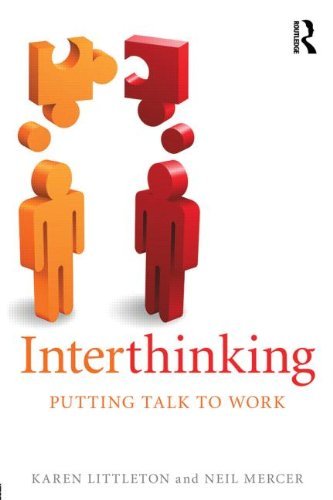
In the book Interthinking by Neil Mercer and Karen Littleton, they examine how thinking develops through social interaction rather than residing solely within individual minds. Drawing on research in education, psychology, and sociocultural theory, they introduce the concept of interthinking to describe how people use language together to reason, learn, and solve problems.
The book explores how different forms of talk shape collective thinking. The authors distinguish among disputational, cumulative, and exploratory talk, showing how each affects understanding and decision-making. They pay close attention to the role of shared norms and ground rules in enabling productive dialogue, particularly in classroom settings.
Although much of the evidence comes from education, the arguments extend to workplaces and other collaborative environments. The authors show that the quality of thinking depends not only on individual ability but also on how people engage with one another through language. The book offers a clear account of why conversation matters for learning and joint reasoning.


As an Amazon Associate, I earn a small commission when you purchase a book via this site.
- Collective Sense-making Bringing different perspectives together to understand in order to act
- Interthinking Is Real How conversation becomes part of the thinking process
- Interthinking: Thinking Together Why our best thinking often happens in conversation
- Oracy The ability to express oneself in and understand spoken language


Image Credits: Midjourney
 (Public Domain)
If you enjoy my work and find it valuable, please consider giving me a little support. Your donation will help cover some of my website hosting expenses.
Make a donation