In this book, Changing Consciousness, David Bohm and Mark Edwards show how we need to adopt a new way of thinking in order to solve the crises facing the planet. Their thesis is presented in dialogue form, accompanied by a photo essay. Through the examination of a totality or whole system, they suggest that we may Continue reading Changing Consciousness by David Bohm & Mark Edwards (1991)

For both the rich and the poor, life is dominated by an ever-growing current of problems, most of which seem to have no real and lasting solution. Clearly, we have not touched the deeper causes of our troubles. It is the main point of this book that the ultimate source of all these problems is in thought itself, the very thing of which our … | David Bohm Continue reading We Have Not Touched the Deeper Causes of Our Troubles David Bohm
In this book The Empathic Civilization, Jeremy Rifkin tells the story of the extension of human empathy from the rise of the first great theological civilizations, to the ideological age that dominated the 18th and 19th centuries, the psychological era that characterized much of the 20th century and the emerging dramaturgical period of the 21st Continue reading The Empathic Civilization: the Race to Global Consciousness in a World in Crisis Jeremy Rifkin (2010)
No problem can be solved from the same level of consciousness that created it. | Albert Einstein Continue reading Solving Problems and Consciousness Albert Einstein (paraphrase of original text)
The Knowledge Age of the past two decades is passing today as the digital revolution and artificial intelligence replace knowledge work. William Halal’s study of social evolution explains how this marks the passage to a new frontier beyond poorly understood knowledge — an “Age of Consciousness” is here. But more pandemics, climate change, gross inequality, Continue reading Beyond Knowledge: How Technology Is Driving an Age of Consciousness by William E. Halal (2021)
Consciousness is everything you experience. It is the tune stuck in your head, the sweetness of chocolate mousse, the throbbing pain of a toothache, the fierce love for your child and the bitter knowledge that eventually all feelings will end. | Christof Koch Continue reading Consciousness Is Everything You Experience Christof Koch
We are moving into a new period of human consciousness which we don’t yet fully understand. When we say a new period of human consciousness, we mean that the perception of the world will be different, at least as different as between the age of enlightenment and the medieval period, when the Western world moved from a religious perception of the … | Henry Kissinger Continue reading We Are Moving Into a New Period of Human Consciousness Henry Kissinger

We each perceive things differently | Clip from An Ecology Of Mind directed by Nora Bateson People: Nora Bateson (1)Nora Bateson Filmmaker, writer, and educatorBooks: Nora Bateson (3)Complex Problems Require an Entirely Different Approach in Assessment, and Action Nora BatesonNora Bateson Filmmaker, writer, and educatorYou Can’t Build Community Nora BatesonQuotations: Nora Bateson (2)Complex Problems Require Continue reading We Each Perceive Things Differently Nora Bateson, Tim Keanini
Technologies are not mere exterior aids but also interior transformations of consciousness and never more than when they affect the word. | Walter Ong Continue reading Technologies Are Not Mere Exterior Aids Walter Ong
In this book, Future Minds, Richard Yonck challenges our assumptions about intelligence — what it is, how it came to exist, and its place in the development of life on Earth and possibly throughout the cosmos. Taking a Big History perspective — over the 14 billion years from the Big Bang to the present and Continue reading Future Minds: the Rise of Intelligence From the Big Bang to the End of the Universe by Richard Yonck
Consciousness is central to our experience of the world, yet it remains difficult to explain. The philosopher Thomas Nagel’s famous phrase, “there is something it is like to be”, can make the subject even more confusing. Understanding what he meant provides a simple starting point for exploring consciousness and subjective experience. Continue reading What Is It Like to Be Something? Understanding consciousness, subjective experience, and what it feels like to be conscious
We know that the brain processes information, responds to the world, and produces extraordinarily complex behaviour. But why should any of this activity be accompanied by subjective experience? Why should seeing red, hearing music, or feeling pain actually feel like anything? This is the mystery at the heart of consciousness, and despite considerable scientific and philosophical progress, we … Continue reading The Nature of Consciousness The mystery of the mind
Intelligence and consciousness are often discussed together, and we sometimes use the words almost interchangeably. But they describe two very different things. Intelligence concerns what a system can do, while consciousness concerns whether it has subjective experiences. Understanding this distinction matters as we explore animal intelligence, artificial intelligence, and the possibility that … Continue reading The Relationship Between Consciousness and Intelligence Two different dimensions of mind, behaviour, and experience
Suppose we were able to share meanings freely without a compulsive urge to impose our view or conform to those of others and without distortion and self-deception. Would this not constitute a real revolution in culture? | David Bohm Continue reading A Real Revolution in Culture David Bohm

The question of why human life exists is complex and profound, and touches upon fundamental questions about the nature of existence. Continue reading Why Does Human Life Exist? ** Why are we here?
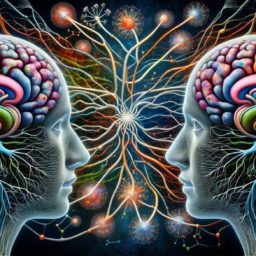
Interbrain synchrony occurs when aspects of neural activity become aligned between people during social interaction. It has been observed during conversation, joint attention, cooperation and other shared activities. The research offers intriguing evidence that interacting brains are not operating entirely independently, although what this synchrony means and what causes it are still being … Continue reading Interbrain Synchrony When neural activities align between people during social interactions

We live in an increasingly interconnected world, yet much of our thinking remains focused on ourselves, our communities, and our nations. The challenges we face, from climate change and inequality to conflict and new technologies, increasingly cross national and cultural boundaries. Global consciousness is about developing a broader awareness of our place in the world, recognising our … Continue reading Global Consciousness Thinking beyond ourselves in an interconnected world