

Good conversation depends as much on group size as it does on the people involved. Many workshops and conferences still organise discussions in groups that are simply too large. Research, together with years of practical experience, shows why groups of three to five create more balanced, engaging, and productive conversations.
Over the years, in running my Knowledge Cafes, I have discovered through trial and error and observation that the ideal size of a group for interactive conversation is three or four people, at most five.
Anything more than five and the conversation does not work so well: one or two people tend to dominate; the conversation breaks into two, even three; frequently, one person is entirely cut out of the interaction, and there is little energy in the group.
This research paper confirms my observations. Here is the abstract:
Current communication models draw a broad distinction between communication as dialogue and communication as monologue. The two kinds of models have different implications for who influences whom in a group discussion.
The experiments reported in this paper show that in small, 5-person groups, the communication is like dialogue and members are influenced most by those with whom they interact in the discussion.
However, in large, 10-person groups, the communication is like monologue and members are influenced most by the dominant speaker.
The difference in mode of communication is explained in terms of how speakers in the two sizes of groups design their utterances for different audiences.
Credit: Group Discussion as Interactive Dialogue or as Serial Monologue: The Influence of Group Size by Nicolas Fay; Simon Garrod; Jean Carletta
So in those workshops and conferences where people sit in groups of 8 at large, round tables (often the only tables available in hotel conference centers) or at long, narrow tables, no real conversation takes place!
To have a good conversation, you need to be within touching distance of each other, and each person in the group needs to be equidistant.
These two settings are ideal:
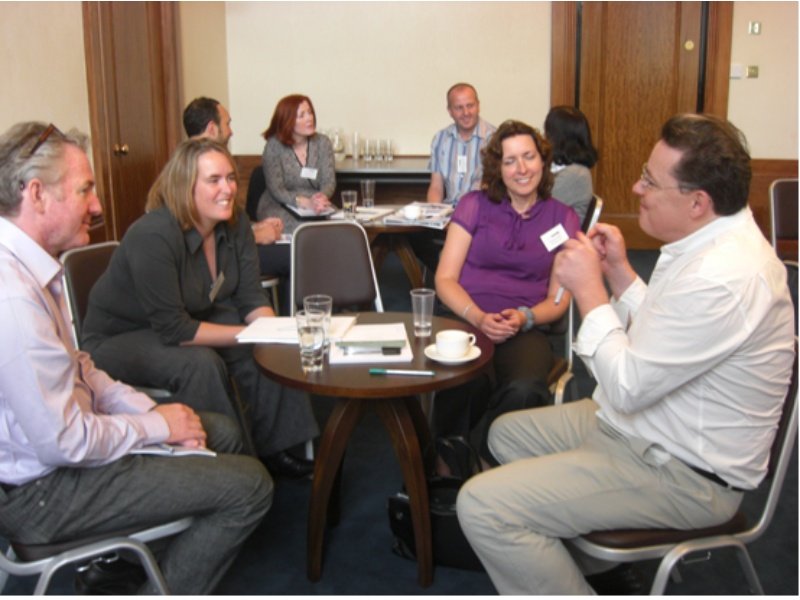

If we want better conversations, we need to pay more attention to how we arrange the room, not just what we plan to discuss. By working in groups of three to five, we give everyone a better chance to contribute, listen, and think together.
Resources


Posts that link to this post
- Knowledge Café: Small Group Design The ideal small group size is three or four
- Practicing Dialogic Thinking How small groups can open and hold shared thinking space
- Social Loafing The tendancy to put less effort into a task when we are part of a group
- The Virtual Random Café Informal conversations and networking ... from home
- What Is a Real Conversation? There is more to conversation than just talking or exchanging messages
This coaching supports you in leading as a practice: initiating conversations that matter, deepening connection, and making space for reflection where it's often missing.