

Organizations are more than collections of individuals. They depend on relationships, shared purpose, and our willingness to take responsibility for the whole. Henry Mintzberg’s concept of communityship challenges the emphasis we place on individual leadership and draws attention to what we can accomplish when leadership, responsibility, and care are shared.
Leadership
Let’s start by talking about leadership, something with which we are familiar. Go Google leadership and you will find a wide variety of definitions. This is my definition:
Conversational Leadership complements this by encouraging dialogue and the exchange of ideas as important ways of enlisting cooperation, building trust, and working together.Leadership is the ability of an individual, through social influence, to enlist the support and cooperation of others in achieving common goals and in building and sustaining a community.
Put simply, leadership is something that someone does. They exhibit leadership. It does not depend on a formal position or title. Most of us possess this ability to some degree.
Anyone who has a sphere of influence can be considered a leader.
Communityship
An enterprise is a community of human beings, not a collection of human resources.
What is this intriguing concept that Henry Mintzberg calls communityship?
At its core, communityship moves our attention away from the individual and towards the community. It recognizes that organizations depend not only on individuals who exercise leadership, but on people who take responsibility for the whole and see leadership as a practice, not simply a position of authority.
Leadership still matters. But it sits alongside the relationships, mutual responsibility, cooperation, and care that allow a community to function well.
We know what a community is, a group of people linked by place, interest, or identity. The word is about who belongs.
Add the Old English suffix -ship and something interesting happens. -ship turns a concrete thing into an abstract state or quality:
- friend → friendship: the state of being friends
- partner → partnership: the state of being partners
- owner → ownership: the condition of being an owner
So when we say communityship, we are not just talking about the group itself. We are talking about the practice and quality of functioning as a community.
It moves the focus from membership to relationship, from structure to the ongoing work of connecting, supporting, and creating together.
Communityship describes the shared responsibility and mutual engagement that makes a collective thrive. Leadership may be about guiding people. Communityship is about cultivating the space where people lead together.
A single suffix changes the frame. From “what we are” to “how we are.”
Community
What do we mean by community? Community is one of those vague, often misunderstood words that some people find unclear or even off-putting. It is frequently used in ways that blur or distort its meaning. Here is how I define it:
A community results from a web of complex and interdependent relationships that form over time among individuals who share common interests, values, and aspirations.
Community members care deeply about one another and work closely together towards a common purpose.
Mintzberg on communityship
Henry Mintzberg describes how we can recognize communityship:
Communityship: Key to an Effective Society | Henry MintzbergHow can you recognize communityship?
That’s easy. You have found it when you walk into an organization and are struck by the energy in the place, the personal commitment of the people and their collective engagement in what they are doing.
These people don’t have to be formally empowered because they are naturally engaged. The organization respects them so they respect it.
They don’t live in mortal fear of being fired en mass because some “leader” hasn’t made his or her numbers.
Imagine an economy made up of such organizations.
Organizations as communities and communityship | Henry Mintzberg (source)
Mintzberg goes further. His argument is not that leadership should disappear, but that we have placed too much emphasis on the individual leader and too little on the community within which leadership takes place.
Isn’t it time to think of our organisations as communities of cooperation, and in so doing put leadership in its place: not gone, but alongside other important social processes.
What should be gone is this magic bullet of the individual as the solution to the world’s problems.
We are the solution to the world’s problems, you and me, all of us, working in concert.
This obsession with leadership is the cause of many of the world’s problems.
And with this, let us get rid of the cult of leadership, striking at least one blow at our increasing obsession with individuality.
Not to create a new cult around distributed leadership, but to recognize that the very use of the word leadership tilts thinking toward the individual and away from the community.
We don’t only need better leadership, we also need less leadership.
Communityship and Conversational Leadership
Communityship and Conversational Leadership belong naturally together.
Leadership is something we can practise as individuals. Communityship is something we create together. Conversation is one of the principal ways in which we do both.
Through conversation we build relationships and trust. We listen to different perspectives, question assumptions, make sense of situations together, discover shared purpose, and decide how to act. Responsibility becomes something that can be shared rather than left to a few people in positions of authority.
Communityship also reminds us that Conversational Leadership is not simply about becoming better at conversation or becoming a better individual leader. It is about our capacity to think, learn, act, and take responsibility together.
The quality of our conversations helps shape the quality of the community we create.
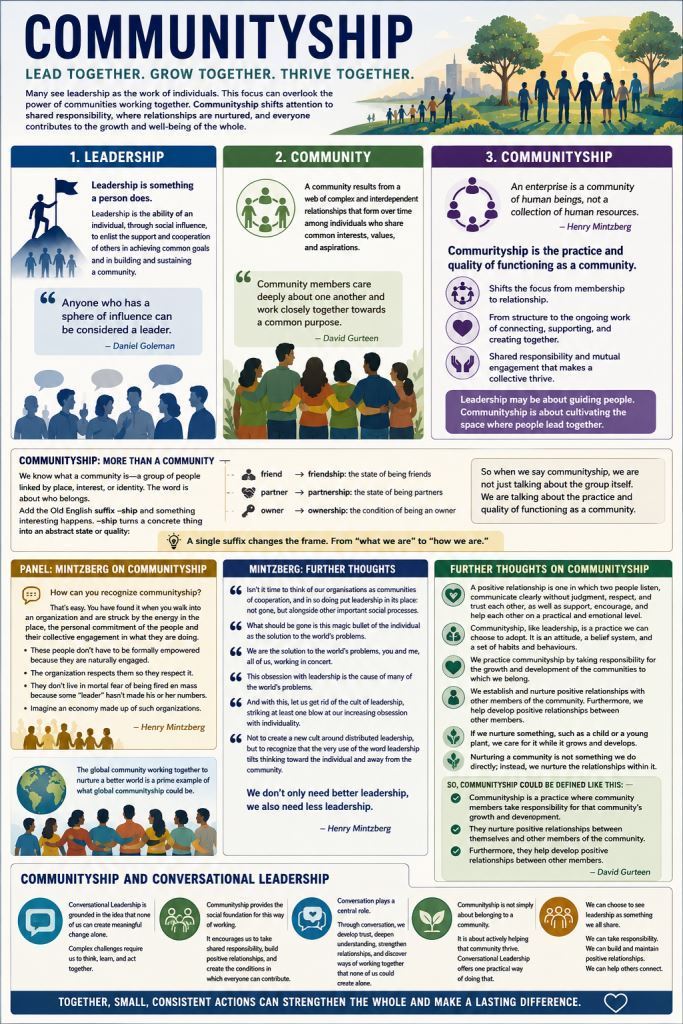
Communityship reminds us that leadership is only part of the story. Organizations depend not simply on individuals who lead, but on the quality of the relationships between us and our willingness to take responsibility for the whole. Through conversation, we can strengthen those relationships, think and learn together, and build communities in which leadership and responsibility are genuinely shared.
Resources
- Article: From leadership to ‘communityship’
Detailed Resources
- Big Think: Humanity solved the “trust paradox” by going tribal — and paid a horrific price by David R. Samson (2023)
- Blog Post: Human Systems Are Almost Always Based On Trust by Dave Pollard
 (2023)
 - HBR: Rethinking Trust by Roderick M. Kramer (2009)
Posts that link to this post
- The Four Levels of Knowledge Management The relation between Conversational Leadership and Knowledge Management
- Three Questions for Meaningful Conversations Clarify focus, approach, and community-building in discussions
In-person, 7–11 September 2026, Warbrook House, Hampshire, UK
We are living and working in conditions of uncertainty, complexity, and rapid change. Many leadership approaches still rely on control, expertise, and tools that no longer fit the realities people face.
This week-long immersive workshop brings people together to practise Conversational Leadership as a shared, lived experience. It is not a training course but a space to slow down, think together, and explore how leadership emerges through dialogue, responsibility, and real engagement.