Our beliefs are not isolated pieces of data that we can take and discard at will. Instead, beliefs are deeply intertwined with other beliefs, shared cultural values, and our identities. To discard a belief means discarding a whole host of other beliefs, forsaking our communities, going against those we trust and love, and in short, challenging our … | Steven Sloman Continue reading Our Beliefs Are Not Isolated Pieces of Data That We Can Take and Discard at Will Steven Sloman
For both the rich and the poor, life is dominated by an ever-growing current of problems, most of which seem to have no real and lasting solution. Clearly, we have not touched the deeper causes of our troubles. It is the main point of this book that the ultimate source of all these problems is in thought itself, the very thing of which our … | David Bohm Continue reading We Have Not Touched the Deeper Causes of Our Troubles David Bohm

Abstract Recent findings indicate interventions can boost executive functions — mental processes that have long been thought to be static and not open to change. The authors examined whether and how short-term social interactions could create such cognitive benefits. Study 1 found that basic get-to-know-you interactions (with or without an explicit cooperative goal) boosted executive Continue reading Friends (and Sometimes Enemies) with Cognitive Benefits: What Types of Social Interactions Boost Executive Functioning? Oscar Ybarra, Piotr Winkielman, Irene Yeh, Eugene Burnstein, Liam Kavanagh (2011)

We are oddly paradoxical creatures who long to be happy while creating our own suffering. We replay past anguish, anticipate future distress, and stew in self-righteous anger. In Hard to Be Human, Ted Cadsby focuses on five cognitive design flaws that foster underthinking and overreacting and reveals powerful strategies to overcome them. Greedy reductionism Addiction Continue reading Hard to Be Human: Overcoming Our Five Cognitive Design Flaws by Ted Cadsby (2021)

This is an external resource such as an article, blog. Below is a summary of the key points from the resource, along with a link to the complete article. The full article can be accessed via the link if you would like to read the content in its entirety. Article: Embodied Cognition by Stanford Encyclopedia Continue reading Embodied Cognition Stanford Encyclopedia of Philosophy (2021)
We often use words like thinking, reasoning, and cognition interchangeably, but they refer to different layers of how we engage with the world internally. Drawing clear distinctions between them helps us become more aware of how we process information, make decisions, and navigate complexity. Cognition: The Broad Landscape Cognition is the most encompassing of the three. It refers to all the … Continue reading Introduction: Thinking Together Cognition, thinking and reasoning
Reasoning is usually treated as a tool for forming sound beliefs and decisions. Yet research on cognitive bias suggests our individual reasoning is often unreliable and shaped by hidden distortions. Social reasoning offers an alternative: we think better together, testing ideas through dialogue and shared critique rather than alone. Continue reading The Argumentative Theory of Human Reason We did not evolve to reason individually but to reason socially
Cognition is a complex process that involves not only our brains but also our bodies, environments, and actions. This is the idea behind 4E cognition, which encompasses the four factors that shape cognition: embodiment, embeddedness, extension, and enaction. It’s common for us to think that all our cognitive processes occur solely in our minds or brains, but this is a limited and potentially … Continue reading Understanding 4E Cognition The multidimensional nature of cognition
Understanding 4E Cognition Mirror Neurons Close Pop-up all posts in this chapter What’s the Vibe? Please be patient as this may take up to a minute to load… Close Cognition is a complex process that involves not just our brain but also our physical body, environment, and actions. This is the idea behind 4E cognition, Continue reading Beyond the Brain The multidimensional nature of cognition
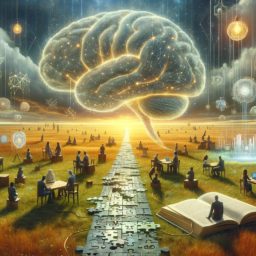
Knowledge and cognition extend beyond our brains, involving people and objects around us. This distributed cognition means our thinking and decision-making are influenced by external factors. Understanding this can improve how we approach problem-solving and collaboration. Continue reading The Extended Mind The power of distributed cognition

Why Face-to-face Interaction Matters ** Verbal Judo ** Close Pop-up all posts in this chapter What’s the Vibe? Please be patient as this may take up to a minute to load… Close Research shows that engaging in short friendly conversations boosts people’s performance on a variety of cognitive tasks. A study in 2011 by researchers Continue reading Friends with Cognitive Benefits Engaging in short friendly conversations improves people’s thinking