

Some lies are not meant to deceive but to control. They demand silence, not belief, and punish those who push back. Naming these as bully lies is the first step toward protecting truth, staying grounded, and creating space for honest conversation, even when the pressure is to conform.
Not all lies are the same. Some are told to avoid blame. Some to gain an advantage. Some are even self-deceptions. But there is a particular kind of lie that operates differently, a bully lie sometimes called the power lie.
A bully lie is not told to convince anyone that it is true. It is said to dominate.
It is often so obviously false that everyone knows it. And that is precisely the point. The power of a bully lie is in what it demands. You know it is a lie, and yet you are expected to nod along, stay silent, or even repeat it out loud.
It is a public test, not of truth, but of loyalty and submission.
The Source of the Concept
In an episode of This American Life, Masha Gessen read from her book Surviving Autocracy, which contains this extended reflection:
Lies can serve a number of functions. People lie to deflect, to avoid embarrassment or evade punishment by creating doubt, to escape confrontation or lighten the blow, to make themselves appear better, to get others to do or give something, and even to entertain.
However unskilled a person may be at lying, they usually hope that the lie will be convincing. Executives want shareholders to think that they have devised a foolproof path to profits. Defendants want juries to believe that there is a chance that someone else committed the crime.
People in relationships want their partners to think that they have never even considered cheating. Guests want the host to think that they like their fish overcooked. These lies can be annoying or amusing, but they are surmountable. They collapse in the face of facts.
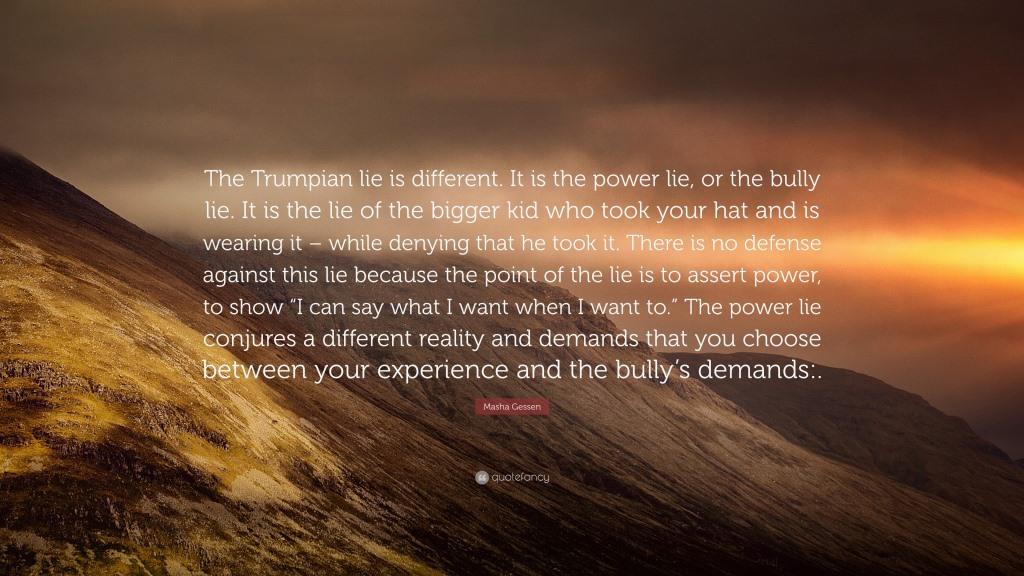
The Trumpian lie is different. It is the power lie or the bully lie. It is the lie of the bigger kid who took your hat and is wearing it while denying that he took it. There is no defense against this lie because the point of the lie is to assert power, to show I can say what I want, when I want to.
The power lie conjures a different reality that demands that you choose between your experience and the bully’s demands. Are you going to insist that you are wet from the rain or give in and say that the sun is shining?
This is the heart of the bully lie. It does not try to persuade. It aims to break resistance.
What Makes a Bully Lie Distinctive?
- It is not about persuasion. It is about submission. The speaker is not trying to convince anyone through reasoning or evidence. Instead, they dare others to push back, knowing most will not.
- The lie is often clearly false. But challenging it carries a price. This becomes a test of loyalty. People frequently feel pressure to conform or risk being mocked, punished, or excluded.
- It is a public display of power. Bully lies are often spoken loudly, repeated frequently, and stated with defiance. The expectation is that others will either agree or remain silent, even when they know the claim is untrue.
- It targets the person who tells the truth. Anyone who challenges the lie risks being labeled as disloyal, dismissed as “fake,” or treated as an outsider. The lie becomes a way to measure who is willing to comply.
Bully lies are not just falsehoods. They are tools of control.
Example: Trump’s Inauguration Crowd
A revealing example of a bully lie from Donald Trump’s presidency came on his first day in office. Standing before the nation, his press secretary, Sean Spicer, declared:
This was the largest audience to ever witness an inauguration, period, both in person and around the globe.
It was not. Photographs and transit data clearly showed a smaller crowd than Barack Obama’s 2009 inauguration. The difference was visible, measurable, and widely acknowledged, except by the Trump administration.
This was not a slip-up or exaggeration. It was a bully lie, a statement so at odds with observable fact that repeating it became a performance of loyalty. It signaled something deeper than spin. It was meant to establish control over reality.
Other Examples from History and Politics
“There are no political prisoners in the Soviet Union.”
In Stalin’s USSR, this claim was an open secret. People knew better. The lie served to maintain fear, suppress dissent, and demand complicity. To challenge it could cost you your freedom or your life.
“The elections were free and fair.” — Belarus, 2020
When Alexander Lukashenko declared another landslide victory, the public erupted in protest. International observers pointed to widespread fraud. The regime’s claim was not meant to convince. It was meant to assert control, even in the face of mass disbelief.
“We are winning the war.” — Vietnam and beyond
Throughout history, leaders have claimed progress in war when none exists. Not to inform, but to suppress doubt and maintain obedience. The cost is not only credibility, but lives.
“The media is the enemy of the people.”
Also used by Trump, this phrase has historical roots in authoritarian regimes. It is a lie designed to isolate citizens from independent sources of truth and shift trust solely to the speaker.
Why This Matters
Bully lies are dangerous because they do more than distort facts. They distort relationships. They silence people, fracture communities, and leave truth hanging in the air, unsupported and unsafe to touch.
They do not succeed by persuading the many. They succeed by intimidating the few who might resist and by normalizing the silence of everyone else.
The Bully Lie at Work: Recognizing and Responding to Subtle Control
Bully lies are not limited to politics. In corporate life, they show up in quieter but equally corrosive forms. Unlike ordinary lies, these statements are often clearly false, yet they demand silent compliance. Their power lies in testing loyalty, silencing dissent, and isolating truth-tellers.
They might appear in performance reviews that misrepresent your contributions, declarations like “everyone supports this decision” when it is plainly untrue, or blanket claims such as “morale is high” during times of burnout. These are not miscommunications. They are performances. The goal is not accuracy but submission. And challenging them can come at a cost.
So what can you do?
Start by noticing. Recognize the bully lie for what it is, not a misunderstanding but a strategic move to dominate. Ask yourself: is this meant to deceive, or to control?
Avoid the reflex to correct the lie publicly unless you are prepared for pushback. Instead, ask clarifying questions, request evidence, or say you will follow up. These moves slow down the performance without escalating it.
If possible, speak privately. A one-on-one conversation may allow space for honesty, especially if the person repeating the lie is also under pressure.
Find allies. Quiet conversations with trusted colleagues can help restore shared understanding and reduce isolation. Even subtle acts of truth-telling, such as acknowledging complexity, inviting multiple perspectives, or refusing to amplify the lie, can open space for others to speak.
If you have some influence, use it to create room for clarity. That might mean questioning a narrative carefully or simply not endorsing it. These small choices are part of Conversational Leadership, where the focus is on truth, trust, and the conditions that allow people to speak honestly.
Responding to bully lies at work is not about dramatic resistance. It is about staying clear-headed in the fog, protecting your judgment, and quietly refusing to surrender reality.
A bully lie is not about belief. It is about power. It asks: Who will speak up? Who will stay silent? Who will obey? And it reminds us that truth is not just a matter of accuracy. It is also a matter of courage.
Resources
POST NAVIGATION
CHAPTER NAVIGATION
SEARCH
Blook SearchGoogle Web Search
Photo Credits: Midjourney (Public Domain)
The Gurteen Knowledge Letter is a free monthly newsletter with over 20,000 subscribers that I have been publishing by email for over 20 years.
Learn more about the newsletter and register here.